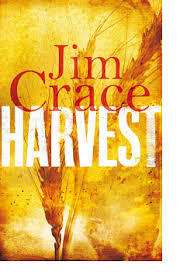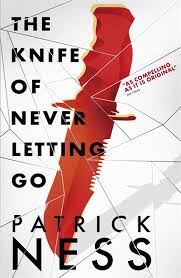
My Kyrosmagica review of The Knife of Never Letting Go by Patrick Ness

download

Synopsis from Goodreads:

Prentisstown isn’t like other towns. Everyone can hear everyone else’s thoughts in an overwhelming, never-ending stream of Noise. Just a month away from the birthday that will make him a man, Todd and his dog, Manchee — whose thoughts Todd can hear too, whether he wants to or not — stumble upon an area of complete silence. They find that in a town where privacy is impossible, something terrible has been hidden — a secret so awful that Todd and Manchee must run for their lives.

But how do you escape when your pursuers can hear your every thought?

My Kyrosmagica review:

thX6CCXIK9

First comment, this is a hell of a tale. Now I can see why this is such a popular series. Right from the start I could hardly put this book down. A great YA combination of  a dystopian, and a coming of age story. The main character Todd, is a twelve-year-old boy on the verge of adulthood, an “almost man.” Patrick Ness uses informal language to suggest Todd’s way of talking, using words such as ‘conversayshun’, effing, ain’t, ya, yer, etc. Todd’s voice shines throughout the story and we develop a very rounded picture of his character, and the other characters in the novel too.

In Prentisstown, you become a man at thirteen, leaving your boyhood well and truly behind. Prentisstown is a weird town, there are no women, and everyone can hear everyone’s noise, and their intrusive thoughts, due to the release of the noise germ. There is no escaping the constant clamour of noise. Ness visually creates this uproar on the printed page with black, bold, writing, thoughts spilling out onto the page.  This is particularly effective, when he intersperses the word “COWARD,” throughout a passage of the story.

It is a town of lies. Who are the Spackle? Are they behind the noise germ? Why are all the women dead?
What happens when you become a man?
thEOVNL6TDMagic

The Knife of Never Letting Go is a shining light of a tale! The narrative begins by introducing us to Todd, who is walking with his dog Manchee, towards the swamp. Manchee is a cute a mutt as you could ever imagine! Initially Todd doesn’t seem to think so, but this soon changes, and Todd can’t help himself from loving man’s best friend, his best friend Manchee. Manchee talks, and so do the other animals, but no one manages to be as engaging as Manchee. Certainly the sheep seem quite boring in comparison!  Manchee’s short abbreviated doggy words such as: get , get Todd, poo Todd, are full of laughs, and  pathos, pulling us in, making us warm to this brave dog. At the beginning of the book, Manchee is Todd’s only companion, Todd has no friends. Prentisstown is not a place for friends, especially when you are on the verge of becoming a man.

To begin with Todd is taken in by the lies that are at the heart of this strange community. His mother and father are dead, and he is looked after by Ben and Cillian, who both love him dearly but have different ways of expressing this love. Todd is shocked to find an area that the noise can’t touch, “The rip in the noise, as big and horrible as life itself.” He stumbles upon Viola. At first he fears she is a Spackle, but she is no Spackle, she is a girl. A girl is a strange phenomenon to Todd. There are no girls or women in Prentisstown. But moreover this girl has no noise. She is silent. The rip in the noise represents a tear in the system. Todd, the last of the young men on the verge of manhood will be the one to question the initiation ceremony that is at the heart of Prentissetown. Todd has to leave Prentissetown, leaving behind Ben and Cillian, and everything he has ever known. Both Todd and Viola are now alone in the world, and as they continue on their adventures to find Haven, a town that represents Hope, the two of them grow closer. To begin with she is silent, and Todd finds it difficult to connect with her, as he can’t hear her noise. But as she learns to trust him, telling him snippets of information, first her name, then details of her parents, Todd begins to understand her, and eventually he is able to sense what she is thinking. The two of them bond and join in an alliance to try to escape the bad guys. There are a host of bad guys in this novel, as you will discover. Todd struggles with his sense of moral right and wrong. The Knife symbolises this temptation, teasing him to become a man, to strike back and defend those he loves and cares for. Ness’s most disturbing antagonist in the novel is without doubt the crazy preacher man, Aaron.

Magic! I would say that Ness’s strengths lie in his ability to create wonderfully absorbing characters that carry you along on an adventure. It is almost as if you are there with Todd and Viola, suffering all that they are suffering. Ness has a wonderful ability with dialogue, with the use of short punchy sentences and hyphens to create a sense of escalating tension.

One of the characters, kept on surviving through circumstances that would have killed most mere mortals, but I think he had to be there at the end, he was central to the ending of the story, and if anyone is going to keep on and on, it had to be him. Hush. No spoilers!

Would I want to read more in this wonderful series? The answer has to be 100% yes. In light of that I am going to award this novel the highest score I have given a YA. Here goes.

star-154143_640 star-154143_640star-154143_640star-154143_640star-154143_640

Highly recommended for fans of YA, and dystopian.

Author Bio on Goodreads:

Patrick Ness, an award-winning novelist, has written for England’s Radio 4 and Sunday Telegraph and is a literary critic for The Guardian. He has written many books, including the Chaos Walking Trilogy, The Crash of Hennington, Topics About Which I Know Nothing, and A Monster Calls.

He has won numerous awards, including the Guardian Children’s Fiction Prize, the Booktrust Teenage Prize, and the Costa Children’s Book Award. Born in Virginia, he currently lives in London.

Patrick Ness is at the YALC Literary convention 12th July. I’m going! Oh and I’ve just noticed he is also at the Edinburgh Festival on 16th August! Yippee, I may be up at that time too! More details about these events are on his website: http://www.patrickness.com/

Have you read The Knife of Never Letting Go? Do leave a comment I’d love to hear from you.

Bye for now,
file

Marje @ Kyrosmagica xx

My Kyrosmagica Review of The StoryTeller Jodi Picoult

download

Goodreads Synopsis

Sage Singer befriends an old man who’s particularly beloved in her community. Josef Weber is everyone’s favorite retired teacher and Little League coach. They strike up a friendship at the bakery where Sage works. One day he asks Sage for a favor: to kill him. Shocked, Sage refuses… and then he confesses his darkest secret—he deserves to die, because he was a Nazi SS guard. Complicating the matter? Sage’s grandmother is a Holocaust survivor.

What do you do when evil lives next door? Can someone who’s committed a truly heinous act ever atone for it with subsequent good behavior? Should you offer forgiveness to someone if you aren’t the party who was wronged? And most of all—if Sage even considers his request—is it murder, or justice?

My review:

thX6CCXIK9

The StoryTeller is a Goodreads Choice Nominee for fiction 2013, and deservedly so. It is told through the differing point of views of Sage, Minka, and Leo.  At the beginning of the novel we meet Sage Singer, a girl who hides herself away working nights in a bakery. She is badly scarred from a car accident, and prefers the solitude of baking bread to engaging with people. Alone in the world after the death of both her father and her mother, she speaks only to the other workers in the bakery and the grief group attendees. At the grief group she meets Josef. A man well into his nineties, who appears to be a sweet old man, well-respected by the local community. He too is alone in the world, his wife has died and all he has left is the unconditional love of his dog.  This unlikely pair of grieving souls form a strange friendship, drawn together by the deep scars, Sage’s visible, Josef’s hidden. Josef’s scars have been inflicted on others. Deep wounds, that he carries within his soul, and seeks release from.

The shocking twist in the tale comes with Josef. He is not at all what he appears to be. In fact nobody would believe that this pillar of the community was an SS Officer during the Second World War, who worked in the notorious concentration camp Auschwitz. To make matters worse Sage’s grandmother is Jewish, and was also at Auschwitz. Sage has not been an active member in the Jewish faith, and works alongside an ex nun.Josef reveals that he wants Sage to help him die. Sage struggles with her conscience and decides that the right course of action is to contact Leo Stain, a Nazi criminal war hunter.

At the core of the StoryTeller is the concept of guilt. Both Sage, and Josef are guilty. Josef’s guilt is on a massive scale, so therefore cannot ever be forgiven.  Sage feels  a sense of guilt,and this guilt is caused by events that may or may not have caused the death of her mother. Her guilt drives her away from the remaining members of her family.  Both Sage and Josef  hide, driven out of sight by their remorse. It is interesting that Jodi Picoult elects that Josef, the heinous war criminal,  is the one to hide away by adopting a new persona. Moreover he gets away with it for many years.   It is evident that his actions as a war criminal are still engrained in his psyche, he knows how to survive. Whereas Sage,  bound and scarred by her own sense of guilt,  chooses to distance herself from people, she is the one who disappears out of sight, who is invisible. Yet her guilt is miniscule compared to Josef’s terrible actions as an SS officer.

Part two of the novel tells us Sage’s grandmother Minka’s story. I found this part of the tale, a shocking progression from her happy childhood memories, to the ghettos, and then to the starvation, deprivation,  and sheer terror, of the concentration camps. Jodi Picoult has obviously extensively researched this period of history, and creates a moving and absorbing tale in Minka’s story. It works so well. She manages to create believable characters whose pain and suffering become so understandable, and poignant. I did find myself wiping away a tear, whilst reading the second part of the novel, so you’ve been warned!

As if this is not enough, Jodi Picoult adds into this mix yet another story of a creature, the Upior, who tears humans apart. This story is Minka’s tale. The story within the story does much to illustrate the horror of what man does to his fellow humans, behaving like a beast.

I also found layers of meaning in the references to baking in the novel. The simple things in life like a freshly baked piece of bread or patisserie, made by a loving parent,  can be taken away from you in mere seconds and replaced by unimaginable horrors.

There are many threads and points of view interwoven into the plot. So this is a novel that works best for close  rather than light reading!   Can a  Nazi war criminal change?   Obviously whatever he has done now to make amends cannot wipe out the terrors of the atrocities that he must have committed. Leo, is the one that keeps this point of view firmly in place, even though at times we see Sage struggling with the same dilemma.

The conclusion of the story focuses on Sage, and her ongoing process of delivering Josef to the authorities. In this part of the book, we learn that Sage struggles with Josef’s confession, and questions of morality are debated via her character. There are major spoilers at the end of the book, so I will not spoil your reading of it by even hinting at them. Just suffice it to say, that this is  a very thought-provoking book, that I would highly recommend to fans of Jodi Picoult, and to readers of historical fiction, it’s a must.

My rating:

4 Candles!

untitled  untitled  untitled  untitled

My favourite Storyteller Quotes:

“Inside each of us is a monster; inside each of us is a saint. The real question is which one we nurture the most, which one will smite the other.”

“I don’t know what it is about death that makes it so hard. I suppose it’s the one-sided communication; the fact that we never get to ask our loved one if she suffered, if she is happy wherever she is now…if she is somewhere. It’s the question mark that comes with death that we can’t face, not the period.”

“What he did was wrong. He doesn’t deserve your love. But he does deserve your forgiveness, because otherwise he will grow like a weed in your heart until it’s choked and overrun. The only person who suffers, when you squirrel away all that hate, is you.”

“You can blame your ugliness for keeping people at bay, when in reality you’re crippled by the thought of letting another person close enough to potentially scar you even more deeply. You can tell yourself that it’s safer to love someone who will never really love you back, because you can’t lose someone you never had.”

Review of The Exiled by William Meikle

theexiled

Goodreads Synopsis:

When several young girls are abducted from various locations in Edinburgh, Detective John Granger and his brother Alan, a reporter, investigate the cases from different directions. The abductor is cunning, always one step ahead, and the only clue he leaves behind at each scene are the brutalized corpses of black swans.

When the brothers’ investigations finally converge at a farmhouse in Central Scotland, they catch a glimpse of where the girls have been taken, a place both far away yet close enough to touch. A land known throughout Scottish history with many names: Faerie, Elfheim, and the Astral Plane. It is a place of legend and horror, a myth. But the brothers soon discover it’s real, and, to catch the abductor, they will have to cross over themselves.

To catch a killer, John and Alan Granger will have to battle the Cobbe, a strange and enigmatic creature that guards the realm, a creature of horrific power that demands a heavy price for entry into its world. The fate of both realms hangs in the balance…and time is running out…

My review of The Exiled, by William Meikle. This is an advanced readers copy that the author has kindly supplied to me via NetGalley. Publication date 1 July 2014.

My review:

The Exiles does much to recommend it. It combines a well crafted detective story, a serial killer thriller, and dark supernatural fantasy, in a work that is gripping and about as original as it gets. The story landscape is Edinburgh, what more could I ask for?The majority of my young adult life was spent in Edinburgh, and the way that William Meikle describes the city, and some of its less salubrious inhabitants and aspects, certainly brought the narrative to life. A large proportion of the detective, and investigative journalistic time was spent in watering holes, persuading half drunk Scotsmen to tell all! The two main characters are brothers, John is a detective inspector, and Alan a journalist with an uncanny ability to research leads. To begin with Meikle paints them as brothers who have grown apart, almost like separate entities, on two sides of the divide. The Macabre nature of the crime draws the two brothers together, in a quest to find and bring to justice the abductor of the missing girls. Meikle manages to interweave a tale that is at times, so dark, that a smattering of black humour, and drunken, humorous elements, are needed to lighten the heavy load. The book is most definitely a page-turner. The characters are realistically depicted. The stress and pressure put on detectives investigating terrible crimes such as these, is realistically portrayed. In fact, John can only seem to cope with the situation by resorting to chain-smoking. moreover, Meikle stereotypes the Scots’ drinking habits, by suggesting that a stiff drink is a prerequisite for all and sundry. Somehow, his realistic, colloquial, dialogue and well crafted scenes, allow him the license to get away with this. Very early on, it’s clear that this is not a novel for the faint-hearted. The darkness, and disturbing graphical images that Meikle paints may well haunt the reader. In light of this, I would not recommend this to younger readers. But, having said that, the darkness of the plot is lightened by the desperation of the two main characters to solve the mystery, and stop the advancing progress of evil. I’m impressed by Meikle’s imagination, and his ability to combine Fantasy with detective genre in such a convincing, and readable way. I would be interested in reading more of his work. I found The Exiled difficult to rate but decided on four stars, though for originality I think it would score a high-five!

Very highly recommended for readers of thriller, dark fantasy, horror.

My rating:

4 stars

imagesFA9DHJ69

ISBN no. 9781940544212 available on Dark Fuse. http://www.darkfuse.com/ and Amazon http://www.amazon.com/

William Meikle’s website: http://www.williammeikle.com/

Information from his website: He is a Scottish genre writer now living in Newfoundland. When he’s not writing Willie drinks beer, plays guitar and dreams of fortune and glory! He has 20 novels and several hundred short stories in genre presses, anthologies and magazines. His current top seller is the sci-fi novel THE INVASION with 20,000 copies sold and counting.

Have you read The Exiled? Do leave a comment below I’d love to hear from you.

Bye for now,

file

Marje @ Kyrosmagica xx

My Kyrosmagica Review of Lola and The Boy Next Door – Stephanie Perkins

51o8T9SqXAL__SL500_AA300_

Goodreads Synopsis:

Lola Nolan is a budding costume designer, and for her, the more outrageous, sparkly, and fun the outfit, the better. And everything is pretty perfect in her life (right down to her hot rocker boyfriend) until the Bell twins, Calliope and Cricket, return to the neighborhood. When Cricket, a gifted inventor, steps out from his twin sister’s shadow and back into Lola’s life, she must finally reconcile a lifetime of feelings for the boy next door.

My review:

An enchanting book. Stephanie Perkins creates wonderfully captivating characters. This book surprised me, I didn’t expect to enjoy it more than Anna and The French Kiss but I did. For all those teenage girls out there obsessed with fashion, and romance, this is the book for you. (My youngest daughter, would adore, ADORE, this book!)

Lola intends to go to her high school winter ball dressed as Marie Antoinette. Lola’s parents, two gay guys, Nathan, and Andy, worry about Lola going out with Max, her rocker boyfriend as he is so much older than her. Nathan and Andy’s devotion to Lola is touching. With the arrival of the Bell twins, Calliope, and Cricket, Lola’s old feelings for Cricket, her first love, are rekindled.

Lola is confused, by the arrival of Cricket, her emotions, seem to be as out of control as her over the top dress sense. Will she come to her senses? Will she discover the Lola within?

file

****BEWARE SPOILERS BELOW****

Cricket is so genuine and cute that Lola can’t stop herself falling for him all over again. Lola’s feelings for Max crumble and her confusion is relatable. It is a shock when she realises that Max is attracted to her child-like self. Lola is no longer willing to be a child. She is now a young woman, on the verge of discovering her identity. Will she go to the ball? She looks at herself in the mirror, and suddenly feels lost in her elaborate costume. Her wig is over the top, dwarfing her personality. Who is Lola? She despairs. Cricket comes to her rescue in the most wonderful way. He enables the Lola that he loves to go to the ball, and then proves that he is “the one,” by re-inventing her, and giving her the most beautiful gift that anyone could possibly imagine.

My rating:

4 stars

Find out more about Stephanie Perkins at http://stephanieperkins.com/books.html

Have you read Lola and The Boy Next Door? Do comment below I’d love to hear from you.

Bye for now,

file

Marje @ Kyrosmagica xx

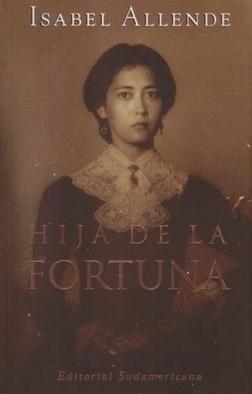
My review of Daughter of Fortune by Isabel Allende

Daughter_of_Fortune

Goodreads Synopsis:

Orphaned at birth, Eliza Sommers is raised in the British colony of Valparaíso, Chile, by the well-intentioned Victorian spinster Miss Rose and her more rigid brother Jeremy. Just as she meets and falls in love with the wildly inappropriate Joaquín Andieta, a lowly clerk who works for Jeremy, gold is discovered in the hills of northern California. By 1849, Chileans of every stripe have fallen prey to feverish dreams of wealth. Joaquín takes off for San Francisco to seek his fortune, and Eliza, pregnant with his child, decides to follow him.

As we follow her spirited heroine on a perilous journey north in the hold of a ship to the rough-and-tumble world of San Francisco and northern California, we enter a world whose newly arrived inhabitants are driven mad by gold fever. A society of single men and prostitutes among whom Eliza moves–with the help of her good friend and savior, the Chinese doctor Tao Chien–California opens the door to a new life of freedom and independence for the young Chilean. Her search for the elusive Joaquín gradually turns into another kind of journey that transforms her over time, and what began as a search for love ends up as the conquest of personal freedom.

My Thoughts

At first I was a little unsure whether I would enjoy this book as it is not the usual genre that I read, but all my doubts were quickly swept away by Isabel Allende’s wonderful storytelling.

It is set in the British colony of Valpraiso, in 1840’s Chile and begins in a humorous way by telling us Eliza Sommers two talents: a sense of smell and a good memory. By the end of the book I discovered that Eliza’s character had grown so much that these two meager talents have increased tenfold.

If I have any criticisms of the novel they are few and far between. There were possibly times when I thought that some of the descriptions were slightly long but overall I didn’t find that this bothered me.

Overall I really enjoyed the book, I think in part due to the diverse characters, the cultural references and the skill of Allende’s writing.

file

*****BEWARE SOME SPOILERS BELOW*****

Eliza is an orphan who was found on the doorstep, raised by Miss Rose, a Victorian spinster with a hidden past, her starchy brother Jeremy, and an Indian servant, Mama Fresia.  Much to the family’s dismay she falls in love with Joaquín Andieta, an unsuitable young man from a poor family, with political ideals that are at odds with the state. Eliza without a thought to consequence, gives herself to this young man, drugging the household, so they will not hear their passionate lovemaking. She is disconsolate when she finds that he intends to go to California to make his fortune in gold. She can do nothing to stop him. He, like so many others is obsessed by the vision of gold, and wealth. Her lover takes off for San Francisco leaving her behind broken hearted. Eliza discovers that she is pregnant with his child, and decides that she has no other alternative left but to follow him.

Eliza hides in the hold of a ship bound for California. She becomes ill and is attended to by Tao, a Chinese doctor.  Tao began his sailor’s life after being shanghaied. He had been drinking to forget his sorrow at the sad death of his young, beautiful wife Lin. On board ship his wife’s delicate ghost comes to him when he is administering to Eliza and berates him for not doing his utmost to save her. He is so distressed by this ghostly vision of his wife that he does everything in his power to help Eliza. Eliza has a miscarriage but survives and escapes from the ship dressed in male clothing. She continues to pretend that she is male to blend in and safeguard her safety. In this land driven crazy by gold fever, single men and prostitutes make up the population. She has no wish to become a prostitute so she chooses to adopt a masculine persona.  In this new world she finds freedom from the restraints of her life as a woman living in a British household in Chile.

Daughter of Fortune has several strengths, Isabel Allende’s characterisation is excellent, I particularly enjoyed her portrayal of several female characters:  Miss Rose, even though she is constrained by female niceties knows how to get what she wants. Paulina manipulates her husband to get her own bank account and eventually buys a steam ship and becomes a wealthy business woman. Though Tao’s wife Lin is described as being weak her ghost manages to find him across the vast expanse of ocean and convinces him to help Eliza.

I also really enjoyed how Allende played with her characters: the intimidating giant Babula the Bad is really a good guy, with a soft side.  In Eliza’s case this transformation is even more marked, as if she is rediscovering herself in stages as the adventure unfolds. She pretends to be a deaf-mute Chinese boy and then the brother of her Chilean lover, and finally she rediscovers her female identity, but this female is no longer chained by layers of corsetry but free to be herself.

Also Tao’s character transforms from his humble start as fourth son to respected Chinese doctor. He learns that his delicate young wife with golden lilies for feet only brings him a fleeting happiness, cut short by her early death, whereas Eliza with her big feet and sturdy body will give him many years of companionship and love.

DISCLAIMER: “As of 13th September 2017 we are a participant in the Amazon Services LLC Associates Program, an affiliate advertising program designed to provide a means for us to earn fees by linking to Amazon.com and affiliated sites.”  

My opinions are my own and any reviews on this site have not been swayed or altered in any way by monetary compensation, or by the offer of a free book in exchange for a review. 

Buying Link:

Kindle Amazon UK: http://amzn.to/2jE5IdT

Paperback Amazon UK: http://amzn.to/2f5PDsA

Audio CD Amazon UK: http://amzn.to/2y8MIH2


My rating:

*4.5 stars*

Bye for now.

file

Marje @ Kyrosmagica xx

There are passages in the novel that are gut wrenchingly sad, but there is also a sense that life is a journey of discovery, with many possibilities open to us.

Find out more about the author at http://isabelallende.com

My Kyrosmagica Review of Strange Weather in Tokyo by Hiromi Kawakami

strange-weather_LR

Goodreads Synopsis:

Tsukiko is in her late 30s and living alone when one night she happens to meet one of her former high school teachers, ‘Sensei’, in a bar. He is at least thirty years her senior, retired and, she presumes, a widower. After this initial encounter, the pair continue to meet occasionally to share food and drink sake, and as the seasons pass – from spring cherry blossom to autumnal mushrooms – Tsukiko and Sensei come to develop a hesitant intimacy which tilts awkwardly and poignantly into love.

Perfectly constructed, funny, and moving, Strange Weather in Tokyo is a tale of modern Japan and old-fashioned romance.

My review:

I’m a huge fan of Japanese literature and Strange Weather in Tokyo didn’t disappoint. I just loved its quirkiness. Hiromi Kawakami’s writing style has a strange, earthiness, that quietly draws us in. The writing is stark and simplistic portraying Tsuikiko’s loneliness and the growing emotions that slowly develop between the pair of main characters.

Lonely Tsukiko, a woman fast approaching forty, lives alone. One evening she meets a former high school teacher, ‘Sensei’, at a bar. The pair begin an unusual friendship, meeting  by chance at a local bar. He is  an elderly, retired gentleman, who is  full of vigour. She assumes that he is a widower. Delicate details of his character keep us guessing. He carries a briefcase around with him, wears a tweed suit, and leather shoes, even when he goes hiking!

The odd couple continues to meet up, and share food and drink sake. The plentiful Japanese food references will keep foodies like me in rapture.

Sensei’s thoughts on tofu: “Tofu is quite special…it’s good warm. It’s good chilled. It’s good boiled. It’s good fried. It’s versatile.”

“It was sort of like an octopus version of shabu-shabu. Thin, almost-transparent slices of octopus were submerged in a gently boiling pot of water, and them immediately plucked out with chopsticks when they rose to the surface. Dipped in ponzu sauce, the sweetness of the octopus melted in your mouth with the ponzu’s citrus aroma, creating a flavour that was quite sublime. ”

You can just taste the octopus!

We discover little snippets of information about Sensei’s past, his wife’s abandonment of him and their son. In time,  Tsukiko realises that when she’s not with him, she misses him, and wonders how she managed to be happy before. This slow developing almost dream-like sense of their growing feelings for each other slowly develops into love, despite the difficulties associated with a large age gap. The author depicts Tsukiko, in a child like fashion. So in a sense the teacher, student aspect of their relationship still remains. Though Sensei, seems fitter than her! This is amusingly related in the mushroom hunting chapters. The novel is interlaced with a delicate humour, and a sweet sense of sadness, as the couple come to terms with the inevitability of life.

“At some point, sitting beside Sensei, I began to notice the heat that radiated from his body. Through his starched shirt, there came a sense of Sensei. A feeling of nostalgia. This sense of Sensei retained the shape of him. It was dignified, yet tender, like Sensei. Even now, I could never quite get a hold on it – I would try to capture it, but the sense escaped me. Just when I thought it was gone, though, it would sneak back up on me…Wasn’t a sensation just that kind of indistinct notion that slips away, no matter how you try to contain it?”

My rating:

5 stars!!!

5_stars_clipart

About the author

Kawakamki is one of Japan’s most popular contemporary novelists. Strange Weather in Toyko won the Taniziki prize in 2001, and was shortlisted for the Man Asian Literary Prize in 2013.
.
Strange Weather in Tokyo
By Hiromi Kawakami, 2013
Translated by Allison Markin Powell
Portobello Books www.portobellobooks.com

This is one of the summer reads suggested by the Writers’ Centre Norwich, and the Library Services in Norfolk, Suffolk and Cambridgeshire, UK. www.summerreads.org.uk

Amazing cover art deserves a mention: http://yowayowacamera.com/

Strange-Weather-in-Tokyo-Image-by-Yowayowa-Camera-Woman1-640x361

Have you read Strange Weather in Tokyo? Do leave a comment below I’d love to hear from you.

Bye for now,
file
Marje @ Kyrosmagica xx

My Kyrosmagica Review of Eleanor and Park by Rainbow Rowell

17322949

Synopsis of Eleanor and Park from Goodreads:

Two misfits.
One extraordinary love.

Eleanor… Red hair, wrong clothes. Standing behind him until he turns his head. Lying beside him until he wakes up. Making everyone else seem drabber and flatter and never good enough…Eleanor.

Park… He knows she’ll love a song before he plays it for her. He laughs at her jokes before she ever gets to the punch line. There’s a place on his chest, just below his throat, that makes her want to keep promises…Park.

Set over the course of one school year, this is the story of two star-crossed sixteen-year-olds—smart enough to know that first love almost never lasts, but brave and desperate enough to try.

Eleanor and Park – Rainbow Rowell: www.rainbowrowell.com

thX6CCXIK9

My review:

The first line sets the tone for the novel, “XTC was no good for drowning out the morons on the back of the bus.” Eleanor and Park takes us back to Omaha, August 1986, on a nostalgic trip for those of us who remember the 1980’s, myself included! The novel is written in both Eleanor and Park’s, point of view, this works well, and gives the novel a deep insight into both male and female teenagers.

There is only one seat available on the school bus and of course this is next to Park, a Korean kid, with a comic obsession, who listens to music to shut out the banter of the popular kids on the bus. To begin with Park doesn’t know what to make of Eleanor, this new kid who ends up sitting next to him on the last available seat. But in time he warms to her, encouraging her to read his comics, and listen to music. Rainbow Rowell uses the confined space of the seats on the bus to good effect, the two teenagers are so close they are almost touching, the reader can’t wait for them to get closer!

images2B2H224D

Eleanor and Park is at its most successful at depicting first love. The little almost imperceptible actions that mean so much, such as Park turning the page for Eleanor as he reads his comic. The words unspoken, the gestures, looking at each others shoes, and admiring them. Even sensory details such as Park reflecting that when Eleanor returned his comics to him they smelt like roses. Above all else, it’s the tenderness of first love, the hand holding, “Holding Eleanor’s hand was like holding a butterfly. Or a heartbeat.” Of course this progresses to their first kiss, and gentle caresses, all these romantic progressions, amount to a heart warming description of first love.

The book also handles a lot of difficult issues, from abusive relationships to bullying.

untitled

Eleanor is bullied because of her size, and dress sense, and because she’s different. Park is culturally different from the other kids, he’s Korean, and this makes him vulnerable too. I related a lot to this as I have experienced problems like this myself when I was growing up, (my mother is Malaysian). Park just about gets by without too much attention by trying to be unobserved, whereas Eleanor draws attention to herself with her weird dress sense. It is as if she is unable to help herself. She is big, white skinned, with shocking red hair, but rather than draw attention away from her hair, or her dress sense she does the opposite, like she is challenging them. No wonder they call her big red. There are even instances when Park wonders what he sees in big Red, at one point he compares her mouth to the Jokers, not exactly very attractive sounding, yet in time he finds her so appealing that he can’t bear to be without her. I really admire this aspect of the story, these two less than popular teenagers, fit together, and nothing else matters. Park accepts that Eleanor is different but rather than putting him off, he finds this attracts him to her. Eleanor perpetuates this by telling him off for calling her “nice,” Park thinks: “Eleanor was right: She never looked nice. She looked like art, and art wasn’t supposed to look nice; it was supposed to make you feel something.” This is one of my favourite quotes from the book. It sums up Eleanor so well in just a few words. Eleanor is happy in her own skin, and this is an appealing quality that readers will admire.

Park’s home life is stable and happy compared to Eleanor’s. Eleanor feels it’s necessary to hide aspects of her sad, home life from Park. He has no idea that she’s so poor. She doesn’t even have a toothbrush, or a phone. But more than that she has to contend with her unpleasant step dad Richie, and his nasty behaviour on a daily basis. Her mother comes across as this weak individual unable to stand up to Richie, and the children and herself suffer in this abusive relationship. Eleanor pretends not to notice bruises on her mum’s wrists. It is easier to turn a blind eye than to admit what’s really going on.

Though Rainbow Rowell did a great job in creating this sad backdrop of an abusive home life, I do think that the developing love story between Eleanor and Park is more powerful, emotive and effective, than the other aspects of the novel, which could have been developed more. Though this would have altered the tone of the novel making it a more serious read, and Rainbow Rowell works best on a light-hearted level.

thOOMT5AOK

Photos courtesy of free domain photos.

Have you read Eleanor and Park? Do comment I’d love to hear from you.

Bye for now,

file

Marje @ Kyrosmagica xx

My Kyrosmagica Review of Harvest by Jim Crace

imagesZW1F4B9U

Goodreads Synopsis of Harvest:

On the morning after harvest, the inhabitants of a remote English village awaken looking forward to a hard-earned day of rest and feasting at their landowner’s table. But the sky is marred by two conspicuous columns of smoke, replacing pleasurable anticipation with alarm and suspicion.

One smoke column is the result of an overnight fire that has damaged the master’s outbuildings. The second column rises from the wooded edge of the village, sent up by newcomers to announce their presence. In the minds of the wary villagers a mere coincidence of events appears to be unlikely, with violent confrontation looming as the unavoidable outcome. Meanwhile, another newcomer has recently been spotted taking careful notes and making drawings of the land. It is his presence more than any other that will threaten the village’s entire way of life.

In effortless and tender prose, Jim Crace details the unravelling of a pastoral idyll in the wake of economic progress. His tale is timeless and unsettling, framed by a beautifully evoked world that will linger in your memory long after you finish reading.

Here’s an Extract from ‘To Penshurst’ by Ben Jonson that brings to mind the pastural idyll, before the enclosure act was enforced:

Thy copse too, named of Gamage, thou hast there,
That never fails to serve thee seasoned deer,
When thou wouldst feast or exercise thy friends.
The lower land, that to the river bends,
Thy sheep, thy bullocks, kine, and calves do feed;
The middle grounds thy mares and horses breed.
Each bank doth yield thee conies; and the tops
Fertile of wood, Ashore and Sidney’s copse,
To crown thy open table, doth provide
The purpled pheasant, with the speckled side:
The painted partridge lies in ev’ry field,
And for thy mess is willing to be killed
And if the high-swollen Medway fail thy dish
Thou hast thy ponds, that pay thee tribute fish,
Fat aged carps that run into thy net,
And pikes, now weary their own kind to eat,
As loth the second draught or cast to stay,
Officiously at first themselves betray.
Bright eels that emulate them, and leap on land,
Before the fisher, or into his hand.
Then hath thy orchard fruit, thy garden flowers,
Fresh as the air, and new as are the hours.
The early cherry, with the later plum,
Fig, grape, and quince, each in his time doth come:
The blushing apricot, and woolly peach
Hang on thy walls, that every child may reach.
And though thy walls be of the country stone,
They’re reared with no man’s ruin, no man’s groan;
There’s none, that dwell about them, wish them down;
But all come in, the farmer and the clown;
And no one empty-handed, to salute
Thy lord and lady, though they have no suit.
Some bring a capon, some a rural cake,
Some nuts, some apples; some that think they make
The better cheeses bring them, or else send
By their ripe daughters, whom they would commend
This way to husbands, and whose baskets bear
An emblem of themselves in plum or pear.
But what can this (more than express their love)
Add to thy free provisions, far above
The need of such? […]

(Text reproduced from ‘To Penshurst’ by Ben Jonson, 1616)

thX6CCXIK9

This is a book which perhaps I wouldn’t have chosen to read, so I have to thank the book group that I belong to, for widening my appreciation and taste in books! I have to admit that I found the opening chapters a slow and heavy slog, almost like I myself was a member of this village community where the pace of life is dictated by the unrelenting demands of the harvest. I am glad that I persevered as without doubt this is a wonderfully evocative novel. Crace’s often poetic writing carries you along, every word, sentence and metaphor seems to be perfectly sculpted. His descriptive prose is without doubt his forte. I struggled to rate this novel, but in the end I decided to give it 4 stars, as I found the characters, while good, played second fiddle to the prose.

Crace evokes a long-lost village during the time period of the enclosure act somewhere between 1750 and 1860. He creates a sense of belonging, of families with long allegiances, and a deep-rooted suspicion of newcomers, and change. When the master’s dovecotes are burnt down, it is evident who the perpetrators are, yet it is a family of outsiders who are blamed. The main character in the novel, the narrator, Walter Thirsk, realises that the newcomers are innocent, but the community doesn’t want to blame their own, they’re are happy to accept these unwelcome outsiders as a scapegoat. From this duplicity, this harsh and unfair behaviour, a disastrous chain of events follow with terrible consequences for all of the community. This is a moral tale, a tale of the economic power of landowners over their subordinates, a tale in which change is coming, unwelcome change, that will strike at the core of the villagers’ life.

The narrator’s character left a lasting impression on me. He seems well-intentioned, but never has the courage of his convictions to stand up and speak for what is right. I can’t quite picture him, he seems a shadowy figure, living amongst the community but not accepted into the heart of it. This lack of detail has been judged by some reviewers to be a negative aspect of the novel. It is my impression that it was probably Crace’s intention to depict Thirsk in this way, as a man who lives amongst the villagers, but is never quite one of them. Quite a brave move, as this will distance the reader, but for me I think it works, because this is one of the central theme’s of the novel, a stranger is never really accepted into this community unless he has been born and bred into it. This lack of courage attributed to Thirsk is also true of Thirsk’s Master, Master Kent, a kind but weak man. Mr. Earle, a newcomer, invited into the community by Master Kent, shows more pluck and courage than the other characters. He is given several names by the local inhabitants of the village, and the newcomers blamed for the fire, are also given a name that is not their own, suggesting that all newcomers are viewed with suspicion. Superstitions abound, and suspicion and superstition go hand in hand, in this land of rituals, and harvests.

Humour and sexual innuendo are used to enliven the prose. Insight into life in rural England under the rule of unscrupulous landowners is characterised in the arrival of Master Kent’s cousin, a punitive, cold-hearted man. This is a novel of loss, human weakness, destruction of a way of life, and engrained ties to the land.

harvest

There is a heady mix of lightness in the rituals of the harvest, the crowning of the Gleaning Queen, followed by the darkness of all that happens thereafter.

Magic: My Conclusion

imagesHX22CU8B

I would say that I found the second half of the novel more gripping, and magical, than the first half. Reviewers have used the terms “hallucinatory” and “hypnotic” to describe Harvest, I believe that Harvest is worthy of these two terms, depicting a bygone age, when time came and went by slowly with each harvest, and customs and rituals were held in great esteem. If this is indeed going to be Crace’s last book, he should be proud that he has ended his long-standing writing career on such a deserved note, with high acclaim, and a place on the Man Booker shortlist. I would recommend this to readers who enjoy the detail of thoughtful literary and historical fiction. Perhaps it will be a book I will return to, it seems worthy of a second reading.

My favourite quotes from Harvest:

“Any hawk looking down on the orchard’s cloistered square, hoping for the titbit of a beetle or a mouse, would see a patterned canopy of trees, line on line, the orchard’s melancholy solitude, the jewellery of leaves. It would see the backs of horses, the russet, apple-dotted grass, the saltire of two crossing paths worn smooth by centuries of feet, and two grey heads, swirling in a lover’s dance, like blown seed husks caught up in an impish and exacting wind and with no telling when or where they’ll come to ground again.”

“On nights like this, when there is anxiety about, there is a glut of lovemaking. Then the moon is our dance master. He has us move in unison. He has us trill and carol in each other’s ears until the stars themselves have swollen and ripened to our cries. As ever here, we find our consolations sowing seed.”

Bye for now,

file

Marje @ Kyrosmagica xx

My Kyrosmagica Review of Shatter Me by Tahereh Mafi

images

Here is a short Synopsis of the book courtesy of Goodreads:

I have a curse
I have a gift

I am a monster
I’m more than human

My touch is lethal
My touch is power

I am their weapon
I will fight back

Juliette hasn’t touched anyone in exactly 264 days.

The last time she did, it was an accident, but The Reestablishment locked her up for murder. No one knows why Juliette’s touch is fatal. As long as she doesn’t hurt anyone else, no one really cares. The world is too busy crumbling to pieces to pay attention to a 17-year-old girl. Diseases are destroying the population, food is hard to find, birds don’t fly anymore, and the clouds are the wrong color.

The Reestablishment said their way was the only way to fix things, so they threw Juliette in a cell. Now so many people are dead that the survivors are whispering war – and The Reestablishment has changed its mind. Maybe Juliette is more than a tortured soul stuffed into a poisonous body. Maybe she’s exactly what they need right now.

Juliette has to make a choice: Be a weapon. Or be a warrior.

I was amused by the author’s About Me on Goodreads:

Tahereh Mafi is a girl. She writes books and reads books and drinks way too much coffee.

Very cute!

BOOKS: QUALITY OF WRITING

Shatter Me is the first in a trilogy by author Tahereh Mafi. When I looked inside I was surprised to see strikeouts within the text of the book. How could such an artistic cover house such odd strikeouts? It seemed almost criminal. What was the author trying to do? As I read on, I found that Tahereh Mafi’s style of writing fitted the style of the book, the strike outs were different, suggesting Juliette’s desperation at the bleakness of her surroundings, the loss of freedom, and her awful predicament etc. The line represented for me a stark black, strike through, like a prisoner counting off their time in captivity, for a crime that they did not intend to commit.

Then to add to this heady mix Tahereh Mafi inserts repeated words. Again, these suggest to me her desperation, and confusion. There are times when I found the extra words somewhat distracting, although Mafi has to be applauded for the originality of her ideas, very clever indeed.

Overall, I enjoyed Shatter Me, even though I found the beginning a bit slow. There are parts of the book that I found quite beautiful. The following quote is my favourite:

“I spent my life folded between the pages of books.
In the absence of human relationships I formed bonds with paper characters. I lived love and loss through stories threaded in history; I experienced adolescence by association. My world is one interwoven web of words, stringing limb to limb, bone to sinew, thoughts and images all together. I am a being comprised of letters, a character created by sentences, a figment of imagination formed through fiction.”

thGP5RHQQ3 crystal cave

CRYSTALS: Was there lightness and darkness? A depth to keep me interested?

There is darkness in Juliette’s predicament, she is unable to touch anyone. Can you imagine what that must be like? So it’s not surprising that the story is intense, and the words are lyrical. The lightness comes in the form of the male character in the book, Adam, Juliette’s love interest. I found the romance between the two of them sudden, intense, and at times quite hot! Juliette has the sense to see that Warner, the villain, is a nasty piece of work, a psychopath, who she would do well to avoid.

imagesHX22CU8B

MAGIC: Ending and Recommendations.

The ending allows for a smooth transition to the next book in the series. I would recommend Shatter Me to readers who enjoy dystopian or post-apocalyptic fiction, and anyone who enjoys YA. In the sequel, I look forward to discovering more about their dystopian world and about the two factions, and more romance from Juliette and Adam. I will definitely read the second in the series. Great titles too, and fantastic art work on the cover – love the eye!

My rating:

3.75 stars

http://www.taherehbooks.com/

https://www.goodreads.com/review/list/20419289-m-mallon

file

My Kyrosmagica Review of Matt Haig’s Echo Boy for Net Galley

images

Goodreads Synopsis:

Audrey’s father taught her that to stay human in the modern world, she had to build a moat around herself; a moat of books and music, philosophy and dreams. A moat that makes Audrey different from the echoes: sophisticated, emotionless machines, built to resemble humans and to work for human masters. Daniel is an echo – but he’s not like the others. He feels a connection with Audrey; a feeling Daniel knows he was never designed to have, and cannot explain. And when Audrey is placed in terrible danger, he’s determined to save her. The Echo Boy is a powerful story about love, loss and what makes us truly human.

Did it succeed in my Books, Magic, Crystals ratings, system? Yes it did. A well deserved 4 of 5 stars

BOOK: Quality of Writing

thX6CCXIK9

My Netgalley review of Echo Boy, by Matt Haig. I couldn’t have picked a better book to review for my first Netgalley assignment! I have to confess that I wish I had written this myself, just a tad jealous! The impact of the advancement of technology is of great interest to me. What effect will progress have on humanity? Will we lose sight of ourselves along the way? Will we still retain a thread of what makes us human? So many questions! A topic that is close to my heart.

I don’t usually read science fiction but Matt Haig’s Echo Boy really captured my attention. The narrative delved into the future but did an admirable job of asking those questions. It is a riveting read, with well-developed characters, and a plot that keeps you interested throughout. At the end of the book, I was struck with a touch of melancholy. There must be more. I wanted to know what happens next. I have heard that there is to be a sequel. I am so delighted, this is just such a thrilling book. I enjoyed it enormously, and am looking forward to reading more of Matt Haig’s books.

thDELIE2KI Crystal fountain

CRYSTAL: Is there lightness and darkness in the novel? YES there is.

file

***BEWARE MAJOR SPOILERS BELOW ***

The story begins with Audrey’s mind log, two weeks since her parents were killed. Audrey is a fifteen year old living in the future. Her idea of old-fashioned is singing songs from the 2090s. There is a definite sense of human isolation in the novel, “only a hundred years or so’ ago people knew their neighbours. Climate change has had such a devastating impact that Audrey and her family live in a stilt house, above water, and parts of the world are blisteringly hot deserts. There is a magrail outside their house that allows them to travel more than 300 kilometres in less than ten minutes. Life has been reduced to an instant. Audrey lives in a world in which technology has made such enormous advances that there is 4-D footage of her dead parents, in a pod where she can interact with them, as though they are still alive. This cruel advancement of technology adds to her distress.

She knows in her heart that her parents are dead. Her father’s brother is Alex Castle the head of Castle Industries, the leading technological empire in Europe. The two brothers look like each other but have nothing in common, Audrey’s father is a technophobe, who fears that Echos will take over the world. The two brothers are polar opposites in personality, morals, and beliefs. These resemblances and differences are an interesting and important aspect of the novel, cleverly thought out by the author. From the opening chapter we know that her parents deaths are no accident. This is murder. In this futuristic world robots are passe and have been replaced by Echos, Alissa, their family Echo is so human looking that Audrey can’t help but find this disturbing. Like all Echos she is made of human flesh and blood, a picture of perfection, except for a cube of hardware and circuitry in the brain. Alissa, appears to malfunction, she kills Audrey’s parents, this is accomplished in the old-fashioned way with a knife. No technology is required to commit murder just cold hard steel. Audrey manages to get away from Alissa but the technology of the car that she escapes in is controlled by her uncle Alex. She is taken to his house.

In her uncle’s house she meets Daniel, a boy Echo. After witnessing the death of her parents she is terrified of all Echos, but Daniel seems to frighten her more than most. This initial fear turns out to be misplaced, Daniel is a prototype model who knows the truth about her uncle and is trying to help and warn her. Audrey learns that her uncle is a false, scheming man, only interested in augmenting his power and control. He has no soul. His ten-year old son Iago looks cute looking but has psychopathic tendencies like his father. Audrey’s uncle carries on a pretense of being her protector. To begin with Audrey is taken in. But she discovers what he is really like. She finds a message in a book from Daniel, confirming that her uncle murdered her mother and father. Her uncle locks her in her room and arranges for an Echo to kill her. She manages to escape by tricking Iago and blasts her way out of captivity.

Daniel has a lock of human hair in him, this tiny lock of hair is enough to make him experience human emotions, as well as pain. Audrey discovers that her uncle may appear human but in reality he has less compassion and heart than Daniel with his 0.01% of humanity. Her uncle tries to eliminate Daniel’s capacity for human characteristics, and discards him, aware that he may end up in the notorious Resurrection Zone. He controls the Resurrection Zone, a futuristic zoo, where extinct animals, neanderthals, and Echos are subjected to vicious attacks in front of an audience. The passages in the book about the Resurrection Zone, made me think of Rome’s bloody past. The Roman gladiators, and animals in the Colosseum, pain and suffering, existed as entertainment too.

imagesHX22CU8B

MAGIC: Did the ending work? Was it worthy of my magic rating. YES it was.

In the end Audrey and Daniel manage to escape to the moon, the last place that Audrey would ever have considered going to, but now everything has changed. Her parents are dead, her uncle is a murderer, there is no longer anything to hold her to planet earth. If she stays her uncle may kill her. Daniel has nothing left. His maker, Rosella who he loved is dead. So Daniel and Audrey are drawn to each other, like lost souls. They Kiss. Fall in love. But there is a price to be paid for freedom, she must become like an Echo herself, and suffer the pain of branding, or else she will be discovered on the shuttle that takes them to the Moon. Audrey makes this sacrifice, a massive undertaking to become like an Echo, overlooked, and insignificant. Especially if you consider that she will age but Daniel will continue to stay young. What can the future hold for them? Daniel is an Echo, of Rosella’s dead son; a tiny lock of her child’s hair lives within him. Rosella, Daniel’s creator, sacrifices her life to save Daniel. Another poignant moment, in the book, a human makes the ultimate sacrifice. Daniel also suffers as he is part human. A typical Echo without this 0.01% of humanity would never feel pain, or fear, or love. He is distressed by these human emotions, but without these, are we really living? Are we human?

https://www.goodreads.com/review/list/20419289-m-mallon

Have you read Echo Boy? Do leave a comment below I’d love to hear from you.

file

Marje @ Kyrosmagica xx