How many of us would classify ourselves as normal? Is there even such a thing? If there is do we even want to be normal?
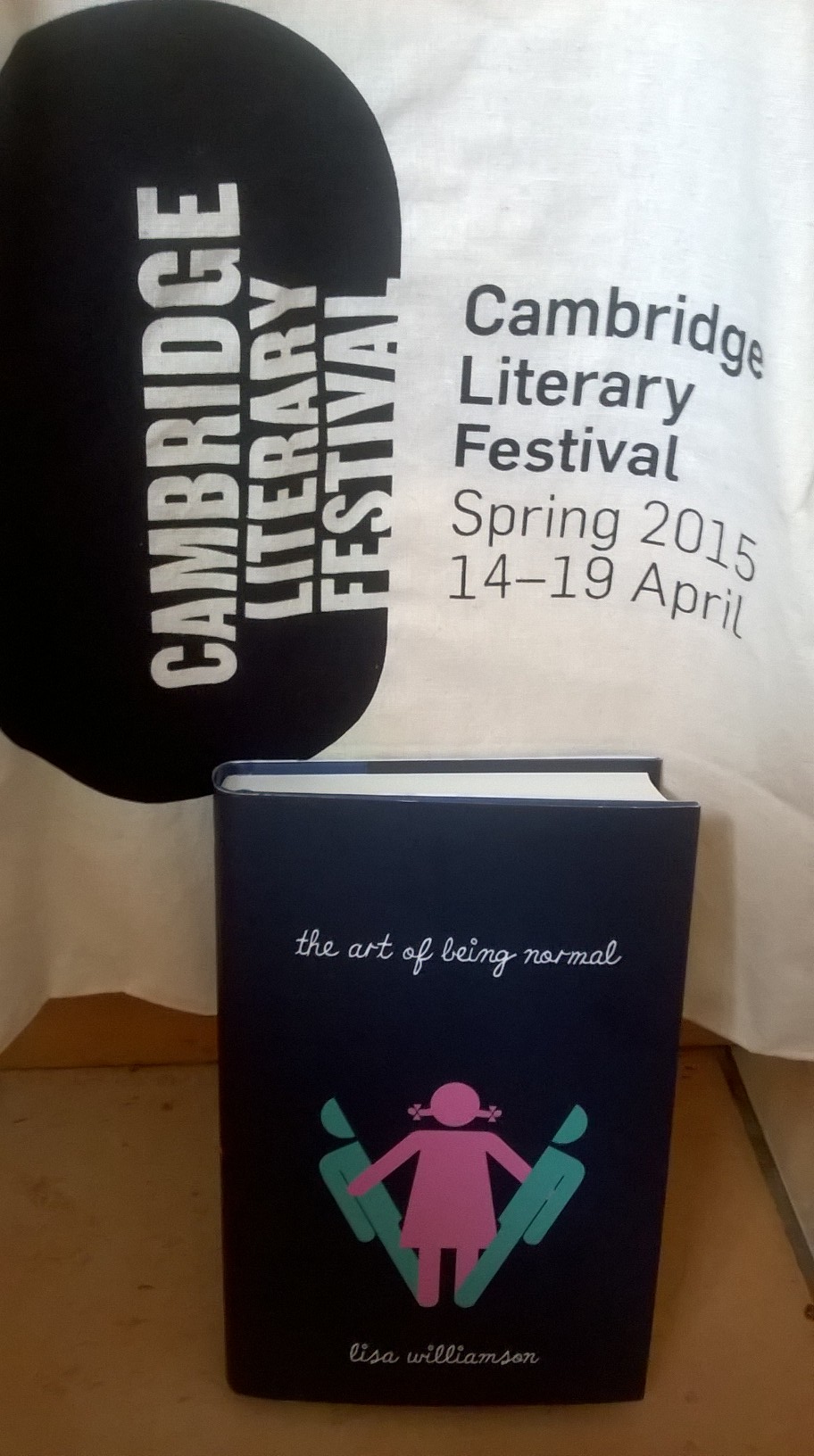
Lisa Williamson’s talk at the Cambridge Literary Festival on Saturday 18th April 2015 was held in the Cambridge Union Blue Room. The proceedings were kicked off in very ebullient style by James Dawson, YA author, of several novels including: Say Her Name, Hollow Pike, Cruel Summer, and This Book is Gay. James eloquently set about reminding us that this talk wasn’t about himself but was in fact about Lisa Williamson, the debut author of The Art of Being Normal.
Lisa began her talk by reading the first chapter of her very well received YA novel: The Art of Being Normal. This chapter only consisted of one paragraph and three short lines, but that’s all she needed to capture the audience’s attention:
“One afternoon, when I was eight years old, my class was told to write about what we wanted to be when we grew up. Miss Box went round the class, asking each one of us to stand up and share what we had written. Zachary Olsen wanted to play in the Premier League. Lexi Taylor wanted to be an actress. Henry Beaumont planned on being Prime Minister. Simon Allen wanted to be Harry Potter, so badly that the previous term he had scratched a lightning bolt on to his forehead with a pair of craft scissors.
But I didn’t want to be any of these things.
This is what I wrote:
I want to be a girl.”
She went on to tell the audience about David, the fourteen year old boy in her novel who is going through puberty. Puberty is difficult enough if you are happy in your body, but if you are a boy who wants to be a girl can you even begin to imagine how difficult that must be? David befriends a new boy called Leo. They form an unlikely friendship. Leo is a bit rough around the edges, and his background is different from David’s, Leo lives in a council estate. This novel is principally about Transgender but it is also a novel about friendship. It sounds to me as if The Art of Being Normal would appeal to a wide range of young YA enthusiasts, and older people like myself who love to read YA, and appreciate a good story about friendship.
Lisa Williamson is not Transgender so how did she come to write about Transgender issues? She is an actress, acting under the name Lisa Cassidy, you may have seen her in the John Lewis commercial, playing Monty the penguin. Of course acting in this particular commercial didn’t inspire her to write about Transgender, this happened quite by chance. She worked a variety of temporary office jobs until she found herself temping in the NHS Tavistock, in the Gender Identity Department. This job was a lucky strike. She typed up notes about Transgender kids, and enjoyed it so much that she decided to work full time in this role. Through this process Lisa began to realise that Transgender kids are “normal,” that they are “just regular kids,” who are unrepresented in YA literature. This lack of representation is remarkable considering the fact that they are “more common than red hair,” as James Dawson puts it. Lisa was nervous about her workplace reaction, and didn’t tell them at the time that she was writing a book about Transgender.
Lisa didn’t use a real Transgender person’s story rather she assimilated various stories and came up with the character of David. Her writing process started with fleshing out the characters rather than focussing on the workings of the plot. James Dawson remarked that the gruff Leo was his “favourite” character!
Lisa is fascinated with “abandoned places,” and the “bleak seaside,” and this shows in the choice of some of the locations in The Art of Being Normal.
Without a doubt it has been an amazing experience for this debut author. From listening to her talk one gets the sense of her feeling responsible for the welfare of the Transgender community. She received a message from one reader who said, that I: ” Don’t feel like I need to hide away anymore.” How wonderful to have had that kind of a positive impact on a young person. She hopes that the book will “change your perception,” and that the “book will speak for itself.”
Of course considering the fact that she is not Transgender herself there were bound to be cries of: “What right does she have to write about this?” But James Dawson argued quite rightly that yes you, “Have to write about characters that are not you.” Who wants to read about themselves? Nobody!
Lisa Williamson’s book was published on the 1st January, so soon after all the excitement of the Christmas festivities. In fact it was such a stressful time that Lisa felt like her eyebrows were falling out, to which James Dawson quipped, that she “can put her eyebrows back on now!”
What about a second book? Somehow this is difficult, the second book is “hell,” there are many pressures, currently she is working on idea six or seven. James Dawson was quick to support her with the encouraging words, ‘Take your time, its fine.” By the time you get to the third book you can relax. No doubt by then, I reckon, Lisa’s eyebrows will have completely recovered their former glory.
An audience member asked about the impact of social media on Transgender kids. Overall both Lisa Williamson and James Dawson seemed to feel that social media is a positive force, and a brilliant resource. This kind of on-line help wasn’t available to young gay men when James Dawson was growing up. Now there is a wealth of on-line resources for authors to connect with and support each other, and for kids to get the help and advice that they need on all sorts of LBGT issues.
Lisa has chosen YA as a means of expression because she loves YA, she believes that YA allows the author to be right there, “pushing boundaries, exploring.” I agree. YA literature showcases a time when everything is fresh and new, but also a time when life is filled with many difficult decisions and issues for the young people she is writing about.
Would the novel have been such a success if it had not been about Transgender issues? Of course the Transgender was a hook, a definite way to get attention, people are fascinated by the unusual, the “unlikely gang,” as James Dawson puts it. There haven’t been many books on this topic, it is so unrepresented, this is also true of LBGT in general.
Lisa’s Williamson’s talk was thoroughly illuminating. I attended with my two teenage daughters, both of whom enjoyed it very much. At the end we went off to buy a copy of the book, and wondered what to ask Lisa Williamson to write at the book signing. Should we ask her to write all our individual names, or ask her to address it to the Mallon family? That sounded a bit ridiculous Addams family like, so we ended up giggling in YA fashion in the signing queue, and opted for all our names to be added individually. Lisa signed the book with a flourish, and in her black pen she highlighted the word normal in a black rectangular box. Some of us might prefer not to be thought of as “normal,” we might like to be a bit special and unique, but some amongst us are just longing to be “normal” as we can and to fit in. We are all a little different, and deserve to be respected for who we are, regardless of our sexual orientation, gender, transgender, race and religion, and long may it remain so.
About the author (via Goodreads)
Lisa was born in Nottingham in 1980. She spent most of her childhood drawing, daydreaming and making up stories in her head (but never getting round to writing them down). As a teenager she was bitten by the acting bug and at 19 moved to London to study drama at university.
Following graduation, Lisa adopted the stage name of Lisa Cassidy and spent several happy and chaotic years occasionally getting paid to pretend to be other people. Between acting roles she worked as an office temp and started making up stories all over again, only this time she had a go at writing them down.
Lisa lives near Hampstead Heath with her boyfriend Matt, where she is lucky enough to split her time between writing and acting. In her spare time she reads a lot of books, continues to daydream and eats way too much ice cream.
I’m delighted to Welcome Ian Probert to Kyrosmagica for a lively Q & A session. Lovely photo Ian. Very casual. That floor is spotless. So, first things first let’s start off with the preliminaries, the getting to know you questions, before I start to tease you into revealing more.
Where do you live now? If you could live anywhere in the world where would that one place be?
I live in Islington and I couldn’t think of anywhere better to live. I’m a bit like Douglas Adams. He was an Islingtonophile. I interviewed him at his house once but ended up spending the afternoon listening to Randy Newman. It was enough to put me off Randy Newman for life. We spoke a lot about John Lennon. He had a bootleg of Real Love, which the ‘threatles’ eventually made into a pretty terrible single. It was a bog shock when he died. But then when isn’t it?
Have you always known that you wanted to write? When did you start writing? Did you have a Eureka moment or did you just come to it gradually?
I’m going to sound big-headed but at school I was only good at two things: Art and English. As a kid I filled exercise books up with terrible stories about vampires. However, as a working class kid growing up in Bristol writing was what other people did. As such I had a succession of dead end jobs until one day I found a typewriter and sent something off to a magazine. I was lucky that the first thing I ever wrote was published. These days I’m more used to rejection.
What inspired you to write? Favourite authors maybe, and/or some other more mysterious source of inspiration/influences?
My first professional job was writing letters to fellow students’ banks at art college. I was paid in beer and discovered that I was really good at it. Inspiration? Well I can give you a list of people that I like: Brett Easton Ellis, Paul Auster, H E Todd to name a few off the top of my head. But they weren’t the inspiration. The inspiration was LIFE. Like most people I occasionally have something to say. I find that I can communicate better through the written word. I’m crap at talking. I splutter and sound like an idiot. My wife is great at this. She tears me to pieces in an argument.
Kyrosmagica – Me too, I communicate better through the written word too. Speaking is much, much harder.
If you could summarise your love of writing in one sentence what would that sentence be?
I’d paraphrase Joseph Turner. ‘Writing is a rummy business.’
What kind of special qualities do you think a writer possesses? Apart from a touch of madness!
A writer or a GOOD writer? There’s a big difference. We all have differing opinions of course, but to me a real writer should be able to hit the ground running. To engage the reader from the first sentence and, more importantly, to make the reader forget that they are actually reading. To me it’s never been about the number of words you know, or where you place the commas. It’s how you present your ideas. It’s ideas that make a writer, not words.
Do you follow any particular routine of writing? Are you a structured writer? Or do you just throw caution to the wind?
I’m completely unstructured. I work when I feel like it at any time of the day or night until I start to bore myself. If I’m bored so will the reader be. That’s not to say that I don’t admire people such as Nick Hornby and Zadie Smith who, I believe, rent offices and treat writing like a 9-5 job. It’s horses for courses.
Kyrosmagica – I’m unstructured too. So identify 100% on that one.
Would you consider yourself an introvert, extrovert, a people person or an animal lover? Sorry, for the silly question but I reckon a lot of writers are animal lovers, and well there seems to be two writing camps, shy writers and more outgoing ones, and those who are just plain obsessed with their dogs and cats. Or a family man perhaps? Just trying to get a handle on you as a person.
Who is Ian Probert?
I’m old enough to recognise and to have come to terms with the fact that I’m completely weird. My wife sees it too. So do other people who know me. I seem to spend most of my life trying to put up a normal front that people will find acceptable. I’m certainly not alone in this. I’m a curious combination of incredible egotist and whimpering insecure baby. A compliment can make me a friend for life, a criticism can make me reach for the switchblade. Years ago a journo at the Big Issue gave one of my books a bad review. I actually waited outside their offices intent on taking it up with him personally. Thankfully he
didn’t appear. Do I like animals? Not really. I don’t understand them. I can see that as a species we have a deep rooted, fundamental urge to enjoy a symbiotic relationship with other creatures; but me, I’d rather have a Playstation. You don’t have to feed it. It doesn’t need walking. It doesn’t cover your clothes in hair. And you don’t have to organise people to look after it when you take a holiday. You can’t play video games on a pet either.
Kyrosmagica – I admire your bravery. All those pet lovers out there will be incensed. Yes, incensed!
What made you write Johnny Nothing? Was the book born out of a sense of boredom, or dissatisfaction with life?
Well it’s been pretty well documented elsewhere that I was very ill for about 15 years and I wasn’t able to write. I was close to death. When I finally got better I had a creative burst of energy and wanted to write something for my ten-year-old daughter, who didn’t have much of an idea that I used to write for a living. It ended up – I hope – being for kids and adults. I think it’s actually a fairly political book. Although naturally there are lots of fart jokes.
Kyrosmagica – So sorry to hear about your illness Ian. Glad you got through it. Must have been dreadful, fifteen years. You deserved one heck load of a creative burst of energy after suffering that long. Oh and what a combination!Politics and Wind. Sounds about right!
How important do you think a title is? How did you choose the title of Johnny Rotten and your other books?
A title is very important. Which is why I didn’t call the book ‘Johnny Rotten’. Had I done that I may well have attracted an audience of ageing punk rockers, which wouldn’t have been such a bad thing. However, I wanted to attract kids. So I called the book ‘Johnny Nothing.’
See what I mean? I’m too sarcastic for words. Make one simple typo and I jump on you.
Kyrosmagica – Oops sorry, Ian, I deserved that! It’s my generation. Johnny tends to equal rotten in my sub-conscious. I must have been listening to punk rock when I typed up the questions.
Since I’ve proven myself to be an incompetent punk rocker I may as well try to redeem myself with a couple of excellent quotes:
John Lydon: “You should never, ever be understood completely. That’s like the kiss of death, isn’t it? It’s a full stop. I don’t ever think you should put full stops on thoughts. They change.”
Freddie Mercury: “Is Billy Idol just doing a bad Elvis pout, or was he born that way?”
Back to my Questions! Who are your greatest supporters and your most difficult critics?
My wife is unbelievable. She has complete and utter faith in me. Which is something that I certainly don’t have. If it wasn’t for her I would probably stop writing and become a waiter or something. Most difficult critic? All of them. I can’t think of a writer who can take any criticism. Most writer refuse to read reviews because they find it too hurtful. I can have hundred good reviews but the bad one is the only one I will remember.
Kyrosmagica – It must be tough. I am always very aware of this when I’m reviewing, I try to be honest, and fair. People forget how much time and effort authors invest in their writing. Writers bare a little bit of their souls on public display.
I think the choice of illustrations in a book can make or break a book, do you agree? There is a darkness to the illustrations which makes the book visually startling and different. How did you find the illustrator for Johnny Nothing?
Kyrosmagica – This is the moment when I confess that I want to kill you, a writer and an artist, how talented can one person be!UGH! Take a look at the artwork from Johnny Nothing and cry!
Johnny Nothing
Uncle Marley
Organist
Reporter
Felicity
God
Vicar
Johnny
Tramp
Kiss
I’m over that outburst now. BACK TO MY Q AND A!
I believe you have self-published and also traditionally published. What are the pitfalls of both methods, and what method of publishing would you recommend to debut authors?
Oh blimey. I’m still trying to get my head around this myself. I don’t know. In traditional publishing you might get an advance and some help with the marketing but not much else. They get you in the papers but take 80% of your earnings. Most traditional publishers still expect you to do the bulk of the marketing. In indie publishing you get no advance but a bigger slice of the pie. Obviously you have to do all the marketing yourself, which is really hard. Did I say INCREDIBLY, UNBELIEVABLY difficult? Newspapers won’t review your books and you struggle to get on the radio or telly. I don’t think that either method is satisfactory but I do enjoy the independence of indie publishing. I do, however, miss interacting with other human beings.
If you could choose one quote to inspire others to write what would it be?
‘Marley was dead to begin with…’ If you can begin a book better than that you’re going places.
Kyrosmagica – Ha Ha! Scrooge, Humbug!
What are you working on now?
Something called ‘Dan’s Dead’ in which the hero dies on the very first page. It’s going to be a pretty short book!
Kyrosmagica – Sounds intense, but intense is good.
Now here’s to a wonderful excerpt of Johnny Nothing. CHEERS! ENJOY!!!!
EXCERPT OF JOHNNY NOTHING
Bill had a shaven head and was wearing a blue tracksuit. He was almost seven feet tall and built like an outdoor toilet made of brick. Bill didn’t realise this but he was a distant descendent of Neanderthal Man. He had only one eyebrow – one long bushy eyebrow that reached right across his forehead. He looked like what you might get if you force fed a member of Oasis with a half-tonne black plastic sackful of steroids. And if you were brave enough to be present when he took off his tracksuit you would discover that his back was so covered in hair that he was able part it with a comb. If Bill had had more of an interest in fashion, he might even have considered giving it a curly perm and perhaps a few extensions. On his right arm, Bill had a tattoo which simply read ‘Bill’. This was in case he woke up one morning and forgot who he was. This was actually less unlikely than you might imagine because standing next to him was his twin brother. His name was Ben and he was identical to Bill in every way except that the tattoo on his arm read ‘Bin’ (the tattooist was either South African or not a very good speller). He was wearing a red tracksuit. Bill gave Mr. and Mrs. MacKenzie the tiniest of smiles and managed to grunt ‘hello’. Ben gave the couple exactly the same tiniest of smiles and also managed to grunt ‘hello’.
The two men were standing protectively close to Johnny. They were so large that in the confines of Johnny’s bedroom they looked like giants, which they were. They were so enormous that each of them had their own postcode. They were so gigantic that they had their passport photos taken by satellite. They were so humungous that you could spend all day thinking up rubbishy jokes about how big they were and never adequately describe just how indescribably, earth-shatteringly ENORMOUS they were. By no stretch of the imagination could you call them small (unless, of course, you were a lot bigger than them). The pair of Goliaths were having to stoop slightly so as to avoid head-butting the ceiling, which actually even looked a little scared itself. They were a terrifying sight. Even scarier than a school trip to a Weight-Watcher’s nudist
camp.
There was a long, pregnant silence in the room like this:
Bill and Ben
This eventually gave birth to an even longer post-natal silence, which, in the interest of preserving the rain forests or the battery on your Kindle, I shan’t demonstrate.
The four grown-ups eyed each other nervously. Bill and Ben looked at the Mackenzies like they were looking at insects that could be squashed into pulpy insect juice any time they so desired. The Mackenzies looked at Bill and Ben like they were looking at two giant skinhead Neanderthal bully boys who had just appeared from nowhere in their recently and unexpectedly decorated council flat. Johnny looked a little scared. Finally Billy Mackenzie managed to get his mouth working a little and spluttered: ‘Who are you?’ And then: ‘What do you want?’ There was another long silence – let’s call it a pause – while Bill and Ben looked at each other as if trying to decide who was going to answer. Finally Bill spoke: ‘You the boy’s parents?’ he demanded in a voice that sounded like an angry rhino with horn-ache. Although if he was clever enough he would have realised that this was a rhetorical question. There was yet another long silence (you’ll be relieved to hear that this is the last silence you’re going to get in this chapter) before Billy Mackenzie mumbled ‘Yes’.
‘We’re Johnny’s bodyguards,’ continued Bill. ‘We’re here to make sure that everything’s hunky dory.’
‘Hunky dory?’ Mrs. Mackenzie suddenly found her voice. ‘What do you mean ‘hunky dory”?’
Now Ben spoke: ‘What my brother means to say,’ he explained. ‘Is that we’ve been – how shall I say – contracted – to make sure that this young feller’s affairs are in order.’
‘Get out of my house!’ interrupted Mrs. Mackenzie, suddenly feeling a little braver, although she had no idea why.
Bill and Ben looked at each again for a moment. They did this almost as much as your mum looks in the mirror. Or you dad looks at websites that he shouldn’t be looking at. ‘First of all,’ said Bill, ‘This isn’t a house – it’s a flat.’
‘And second of all,’ said his brother. ‘We ain’t going nowhere. And neither are you.’
‘Johnny who are these men?’ Mrs. MacKenzie asked her son, ignoring the two giants.
‘I’m sorry mum but…’ Johnny started to speak but Bill cut in like a pair of scissors that chops sentences into bits.
‘…What the young feller means to say is that the fun’s over.’
‘The fun’s over?’ repeated Felicity MacKenzie numbly.
‘That’s right,’ continued Ben. ‘You’ve had a right old time. You’ve been spending his money like it’s your own. You’ve been ripping the poor young feller off. And we’re here to put a stop to it. From now on things are gonna be different.’
‘I’ve had enough of this,’ said Mrs. MacKenzie. ‘Nobody speaks to me like this in my house…’
‘Flat,’ corrected Ben.
‘Nobody speaks to me like this in my flat. Billy, call the police!’
As usual Billy MacKenzie did as he was told. He reached into his pocket for his mobile phone. Before he had the chance to even turn it on the gigantic frame of Bill was towering over him.
‘That an iPhone?’ asked Ben.
‘Erm… Yes,’ said Billy, who could only watch as the huge man took it from him and with one hand crushed it into a chunk of buckled metal and shattered touch screen.
‘I think it’s broken,’ said Ben. ‘You ought to take it back to the Apple store. Tell ‘em that you’re not getting a decent signal.’
‘Right!’ cried Mrs. MacKenzie. ‘We’re leaving! You’ll be very sorry you did that. I’ll fetch the police myself!’
Now the giant frame of Bill was standing in front of her. He was holding something in his hand that looked a little like a child’s toy space gun.
‘Know what this is?’ he asked. Although once again he wasn’t clever enough to recognise that this was a rhetorical question.
Mrs. Mackenzie regarded the object for a moment. Then she shook her head.
Whatever it was she guessed that it was not intended to provide pleasure, happiness or fulfilment. Anything that has a trigger and a barrel and goes ‘bang!’ seldom does.
‘Come on Billy!’ she said. ‘We’re leaving!’
Bill stood in front of her blocking the doorway. ‘Not so fast,’ he said, not so slowly. ‘It’s called a Taser. See this little trigger at the front? If I press this it’ll give you a small electric shock. It won’t hurt you…Well not too much anyway.’
Bill raised the object and gently touched Mrs. MacKenzie on the arm. There was a loudish bang and a flash of blue neon light and Mrs. MacKenzie collapsed groaning to the floor. She was conscious but wasn’t able to move her arms and legs ‘Oh my gawd!’ said Billy Mackenzie bravely charging out of the room in terror.
He got as far as the stairs before there was a second flash. He, too, crumpled to the floor. Bill dragged him back into the bedroom by the scruff of his neck.
Johnny Nothing got to his feet and stood over his two parents. He looked anxious. ‘Are they… Are they… OK?’ he gasped.
‘Don’t you worry yourself,’ smiled Ben. ‘Give em a few minutes and they’ll be right as rain.’
‘But they’ll think twice before they try to run off again,’ said his brother.
AUTHOR BIO
Ian Probert has been scribbling down words ever since he learned to spell the phrase: ‘Once upon a time…’. He is the author of Internet Spy, Rope Burns and a bunch of other titles. Internet Spy was a bestseller in the US and made into a TV film. Rope Burns is a book about why books shouldn’t be written about boxing. Ian has also written things for a shed load of newspapers and magazines. When Ian was a student he used to write lots of letters to the bank manager.
“Great new kids book alert! My two are in hysterics reading Johnny Nothing by Ian Probert (and I am too).” Jane Bruton, Editor of Grazia
“Oh, Wow! Dark, sordid, grotesque and hilarious are only a few words I can conjure up to describe this hilarious book.” Lizzie Baldwin, mylittlebookblog
Johnny Nothing is best-selling author Ian Probert’s first ever children book – although adults are enjoying it too. The story of the poorest boy in the world and the nastiest mother in the universe, the book is earning rave reviews. Children and grown-ups are all laughing at this incredibly funny kids book
To celebrate the paperback launch of Johnny Nothing we are offering a free Kindle copy of the book to the first 100 people who Tweet the following message:
@truth42 I’m reading Johnny Nothing by Ian Probert. http://geni.us/3oR8 #YA
#Kindle #kidsbooks
The first ten readers who answer the following question will also receive a signed print of one of the book’s illustrations.
THIS BLOG claims no credit for any images posted on this site unless otherwise noted. Images on this blog are copyright to its respectful owners. If there is an image appearing on this blog that belongs to you and you do not wish for it to appear on this site, please e-mail me with a link to said image and it will be promptly removed.
Eimear McBride’s talk at the Cambridge Literary Festival, discussing her prize winning debut A Girl is a Half-formed Thing, was chaired by Tom Gatti, the culture editor for The New Statesman. As we waited in our neatly formed queue to enter the lecture theatre I and my fellow book enthusiasts were given a copy of The NewStateman. I’ve never received more than a sense of irritation whilst waiting in a queue before, so a free gift was a nice surprise! The talk was held in Trinity College, Cambridge in the Winstanley Lecture Theatre. The venue was a short walk from the market square through a stone archway. I followed a line of people heading through the inner walkways of the College. Inside the Lecture theatre was small and intimate. Eimear McBride was adorned in sombre black apart from her striking blue, thigh length cowboy boots. Was she what I expected? I think the clue was in her colourful boots, this lady thinks deeply about life but has a lighter, more frivolous side too.
Eimear McBride began with a reading of the first paragraph of A girl is A Half-formed Thing. This first paragraph is most probably the most difficult to follow, there is a rhythm to her writing style that takes a while to master. These first words begin in the womb: For you. You’ll soon. You’ll give her name. In the stitches of her skin she’ll wear your say. Mammy me? Yes you. Bounce the bed, I’d say. I’d say that’s what you did. Then lay you down. They cut you round. Wait and hour and day.
Hearing the words spoken by Eimear somehow brought them to life for me in a way that silently reading them just didn’t achieve. An interesting observation considering that Eimear seems to be heavily influenced by her dramatic training. Rather than taking the obvious route to writing, studying English Literature at University, she elected to follow a more dramatic route. In fact she wonders if the close study of English Literature would have made her write a totally different kind of novel. Her two main influencers are Joyce, a major influence in her twenties, and British playright Sarah Kane. Sarah Kane’s play Crave made her dare to be the author she wanted to be, to hold nothing back, to say what she wanted to say. I myself have witnessed Crave, this play was performed by my daughter, an AS student at the time at Comberton Sixth Form college. I found the language of the play and the portrayal of the students disturbing. The original play contains several dark haunting themes with four un-named characters. I can see why Crave would have been one of the influencing factors encouraging Eimear to write her novel, to push the boundaries of what is deemed to be acceptable literature. Eimear mentioned that A girl is now to be a play too, and this doesn’t surprise me at all, I can see that A girl would transfer well to the stage.
Eimear started writing A girl after a burglary in London. All her hand-written notes for another idea were stolen, so she had to start anew. One wonders what may have happened if the burglar hadn’t stolen her long hand notes? Would she have continued to write a different story entirely? Maybe this burglary was a fortuitous twist of fate.
Eimear’s background does mirror some of the story. She grew up in Ireland and came from a very religious background. In fact when she first came to London she was astonished to find that people don’t pray fervently in their living rooms as a daily occurrence. Sadly, she experienced two family bereathments, her father died when she was a child, and her brother Donagh died of a brain tumour. But the boy in A girl is not her brother, and the girl is not her. Of course it was not her intention to write such a harrowing tale. But one can’t help but wonder if this novel is a by-product of her sense of loss? A sad reeling at her brother’s death at a young age?
There are no semi-colons in her novel, horror of horrors, and no complex words. By writing with the minimum of fuss, she hoped to take herself, the author, out of the reader’s experience, so that the reader could experience and interpret the novel as he or she saw fit. In this she has succeeded. Each reader will react to this novel differently, there will be subtle, personal differences, and A girl will not appeal to everybody. Eimear didn’t plot. She hoped that the uncluttered style of writing would make the characters the focal point rather than the sequence of events.
The title of A Girl is a Half-formed thing slipped into a conversation with her husband. This long winded, ungainly stream of words seemed to fit the awkwardness and unstructured essence of the story, so the decision was made, the title was chosen.
I do admire Eimear for standing up for what she believes in. She had a long and difficult path to publication, I believe it took her ten years to get there. It would have been easier if she could have bypassed the unimaginative marketing departments of those publishers who rejected her. I do wish her every success in her future endeavours and hope that her success will make publishers pause and consider novels that don’t fit the usual marketing mould for success.
After Eimear’s interesting and inspiring talk I walked through Cambridge city centre admiring the Christmas lights. Walking past the taxi rank for a brief moment my eyes lingered on the long line of waiting taxis, wouldn’t it be nice to hop into one? But that would be an unnecessary expense. When I arrived at my bus stop I was greeted with two words, Eimear would have been impressed: No Destinations. Had I known all along? I always seem to have these verging on psychic moments. Hey, hold on don’t get all crazy on me!Of course this is sleepy Cambridge not bustling Edinburgh, and it’s Sunday. So I did hop into a taxi, and it cost me much more than a bag of chips. I wasn’t the only one to make the same mistake, a couple I met had to go all the way home to St. Ives, not Cornwall, I hastily add. Their taxi fare would have been a nasty surprise.
On Sunday I was lucky enough to be listening to two American New York Times best selling authors Leigh Bardugo and Maureen Johnson, talking about “Alternative Worlds,” at the Edinburgh Book Festival. Leigh Bardugo’s debut series “The Grisha Trilogy, Shadow and Bone,” is set in an alternative, magical, Tsarist Russia. At the moment this debut series is in the hands of Harry Potter producer, David Heyman, who is considering a film version. Though it is not confirmed as yet, a movie may be scheduled to release in 2014 or 2015.
Maureen Johnson’s Shades of London series is a bloody, paranormal thriller:
The Name of the Star
The Madness Underneath
The Boy in the Smoke (World book day novella)
The Shadow Cabinet
My first impressions were interesting to say the least. Maureen Johnson sat to the right of Leigh Bardugo with a serious expression on her face, the interviewer appeared a bit unsure just how this conversation was going to progress. But as soon as Maureen spoke all those fears were dispelled. Maureen’s first words about her historical tour of London, were ghosts were mentioned at each and every opportunity, was an absolute riot. Maureen doesn’t believe in timid ghosts that genteely move furniture, or boohoo quietly in a corner, no only murderous ghosts are good enough for her! If she ever gets sick of writing I’m sure she could inflict her sense of wit on us as a very successful female stand-up comedian. Anyway the outcome of all these ghosts was a ton load of research. Maureen researched the history of London, ghost lore, and the Jack the Ripper case files. And the result was . . …….. The Shades of London series.
Leigh and Maureen talked about writing research, and world building. We had Leigh falling in love with her book ideas and Maureen reading her work for the tenth time and just dying. Murder, dying, you name it Maureen inflicted it on her poor unsuspecting audience.
Leigh started writing in her thirties after pursuing various careers, latterly she worked as a make up artist, concocting stories whilst she was applying make up to her clients. Maureen is so multi-talented that she writes scripts for the Nintendo DS and PSP versions of the Harry Potter and the Half-Blood prince video game.
Initially Leigh had problems finishing first drafts of novels that she’d started. I really relate to this, sounds so me! Luckily Leigh went on to write not just one stand-alone book but three, her Shadow and Bone series, “feels like a trilogy,” and boy does it deliver.
They talked about plotting, and planning. Maureen’s style wasn’t too structured to begin with but she was soon compiling character dossiers, and histories. Leigh commented that Lainie Taylor doesn’t plot at all. She observed that this could only possibly work if the author had a natural sense of story. Well, I’m a weak plotter, but only time will tell if I have what it takes to get away with this. In my case, a lack of initial plotting wasn’t such a good idea, I had to do loads of re-writes. I’d agree that in that first draft you are telling yourself the story, as Leigh suggests. Maureen referred to “a little toolkit,” to hammer her story into our consciousness. Ouch, sounds painful, steady on there Maureen.
Leigh’s trilogy is written in 1st person with a third person prologue and epilogues. The voice of her novel was hard to find. To begin with her main character’s voice was nice, quiet, and sweet but she soon found a more sour, pragmatic voice for Alina, her main protagonist, a teenage orphan.
Maureen killed off one of her characters before she even got a chance to appear in print. The fifth Martin, the youngest, was obliterated straight away. Well, Maureen jokingly said that babies don’t do much anyway! As an only child herself she was drawn to writing about a big, family, and a wacky one at that. Her final novel, in her Shades of London series, is now in the hands of someone. She jokingly said that she hopes it was actually a Penguin representative and not some random manuscript stealer.
According to Leigh there are some wonderful benefits of being an author, living in your pyjamas is one of them, but killing your characters can be tough. Absolutely agree Leigh, you just live and breathe those characters, they become engrained in your thoughts. Maureen advised us to “Just do it!” No second thoughts or holding back there, Maureen.
Maureen and Leigh closed off the proceedings with a reading. Maureen kicked it off with a very amusing passage from Scarlett Fever and Leigh took us to a dark place to inflict the darkling on us, and I’m still there, hoping that I will eventually manage to escape!
Then finally the discussion turned to the professional aspect of writing that is often overlooked, touring, and social media. Is this a fun aspect or a chore? Leigh said that she didn’t have to do this but she loved it. Oh, and of course her publishers encouraged her to do so. She said that when you’re on a tour you get to see a new city everyday. It’s the best job ever! Be yourself on line, find out where you should connect with your readers, Leigh felt most at home on tumblr.
To begin with Maureen answered this question dead pan. Writing and being a writer are very different, she said. Do what feels right to you. People found me on twitter, and their response seemed to be, you’re a writer?
The question and answer section followed next. There was a bit of a reluctance from the reticent Scottish audience but one brave soul asked whether Maureen had been on one of many of Edinburgh’s haunted ghost trips? Maureen hadn’t had the opportunity but yes, she would have liked to, but she had a feeling that Edinburgh’s ghosts might not be up to scratch. It sounds like Maureen takes a lot to scare her.
The next question touched upon strong female characters, a topic that is most definitely a popular one. Maureen doesn’t like classifying books as boys books or girls books. That just makes her crazy. Leigh made the very valid comment that nobody talks about strong male characters, and Maureen even mentioned that there is some anger towards female characters. I think that we expect so much from our female characters, come on they’re just like us they’re flawed, nobodies perfect. In my opinion that’s what makes them interesting.
Then a young lad in the far corner asked the final question, the one that was no doubt pressing on the lips of many amongst us in the audience, myself included. It went something like this: “Have you any advice for young writers?” Well the tips went along these lines. Maureen told him not to expect too much. She said that her writing was “so bad” to begin with that she deserved these terms: “Arrest me,” “Kill me.” So if you’re writing terribly Maureen suggests that you’re on the right path because as Maureen says this will lead you to your goal of writing well. Thanks, this is so true, totally agree.
Again Leigh touched a chord with me, she said there’s “no expiration date on talent.” Thank you so much Leigh! Again she went on to say that you don’t have to be cute, popular or media genic, (is this even a word, and if so how do you spell it?)
Maureen carried on this tide of inspiration with “Don’t give up,” “Just finish,” Carry on to your “Eyes bleed,” finish that first draft. Maureen were you speaking to me?
Well it was a sunny day, and I came out smiling even more than when I went in. Such an inspiring, talk. I loved it, and guess what, I finished my final edits last night. Yes finally got there and my eyes didn’t even bleed they just blurred a bit. Now, just have to find a publisher. This is going to be the hardest part, but now I feel more prepared for it. I’m writing this in my pyjamas and I have this strong sense of belonging, I think I’ve already joined the writer’s club! Leigh Bardugo and Maureen Johnson were so entertaining and a absolute delight to listen to. I left feeling both inspired, and sure that I have finally chosen the right career path to an Alternative World.
If you could write about an Alternative World what would it be? Do tell, I’m sure it would be fascinating.
To find out more about these great authors websites, click away:
I’m too sexy for this book! Am I talking about myself again? Eh, I think I better confess it was a YALC panel event, and it was rip roaringly entertaining. So of course, I want to share it with you. The chair James Dawson started off the proceedings by donning a fetching crown, announcing his role as Queen of Teen! Well, he deserves the title as he now has his first YA book out, Hollow Pike, watch out, witches never sleep! A very fetching Queen he was too. I was sitting next to my teenage daughter, well she’s eighteen, and still a teenager, just, and I heard her giggling just as much as me throughout the proceedings. This panel event was an absolute MUST.
.
James Dawson introduced us to the panel of fellow authors, Cat Clarke, Non Pratt and Beth Reekles who were more than happy to join in with a frank and illuminating discussion about sex and sexuality in YA. There was no skirting around the issue, sex reared its head and was allowed out to play.
Should writing sexy scenes be an issue in YA?
Why not write sexy scenes? Cat didn’t feel that writing sexy scenes should be an issue. Non said that she was a “horny and curious” fourteen year old. She wanted to read ‘horny and curious’ books. Beth was fifteen when she started writing Kissing Booth.The Kissing Booth was winner of the Most Popular Teen Fiction Watty Award, and was also shortlisted for the Young Adult Romance Novel of the Year in the 2014 RNAs. Non Pratt’s Trouble touches on a subject that all parent’s dread, teenage pregnancy. The overriding opinion of all the panellists: kids are exploring anyway so why not write what’s happening, rather than pretend that it isn’t happening. Well, this takes me back to my teenage self, I remember reading Lady Chatterley’s Lover. I don’t suppose I told my mother I was reading it but there you are. We’ve all been there, done it. Nothing has changed.
What’s the process of writing a love scene? How do you get in the mood?
Passion Flower! Pixabay.com
Beth
I don’t go out and buy a flower. Maybe she should! This Passion flower is getting me in the mood! She watches romantic movies, and reads chick lit, and tries to write with her younger teenage self in mind. What would she have wanted to read at that age?
Non
Likes sex to be graphic, realistic. In order to get in the mood, “she hammers it out!” Her words! She writes her favourite scenes first, drinking, fighting, and sex scenes! Hey, Non, don’t hold back!
Cat
She has a sexy time playlist, via twitter which includes Prince but stays clear of Rod Stewart. She likes to write revenge sex, check out her book, Undone, in Goodreads it is described as ‘A searing story of love, revenge and betrayal.’ Don’t get on the wrong side of Cat, she scratches!
Gatekeepers reaction to sex in YA books.
Non
Fear creates taboos. Parents and children don’t like to think about each other having sex. This sounds fair comment to me! Non didn’t have to alter her sex scenes but she did have a problem with the bureaucracy that tends to accompany school visits. She found that form filling, and opposition on the grounds of parents not liking it or on religious grounds were evident in school visits. All of these can of course be a problem for writer’s of YA ‘sexy’ books.
Cat
Parents don’t like to see sex in YA books. They like to see good, worthy content. It’s crazy. Cat hasn’t had too much trouble with gatekeepers (agents, editors). She has never had to change her books, even though there is an oral sex scene in her book. Cats just get away with so much don’t they?
Yes, I get away with everything! pixabay.com
Beth
Is aware that some of her readership tends to be younger, say eleven years old, so she writes her books with that in mind. When Beth goes on Goodreads she find that parents sometimes have problems with content. Hey, stay away from Goodreads, they’re bound to tell you off!
The chair, James Dawson has so many enlightening things to say. He announces that kids are at the mercy of google and it is better to read a novel than to be subjected to much harder hitting sexual images on google. I absolutely agree.
With that in mind should there be age ratings on books? All the panellists said…………………………. you guessed it NO.
Has Fifty Shades of Grey paved the way?
Both Beth and Non were published after 50 Shades came out so did this make it easier for them?
Beth
Beth felt that Fifty Shades has lifted the taboo to a certain degree.
Non
Fifty Shades was titilatting, and there were fourteen and fifteen year olds reading Fifty shades.
James Dawson steered the panellists onto the subject of Taboos.
Non
Non’s taboos: Religion, alternative hole use! Her words! Prefers good vanilla variety sex, and recommended Helen Walsh’s The Lemon Grove. This sounds a great read. Thanks for the tip Non.
Beth
Religion. Depression. Wary of graphic sex due to the age of her readership.
Cat
Torture. Yes, I agree with her on that one.
What about New Adult?
Non
Don’t believe in New Adult, think it is a marketing tool.
Beth
It’s a way of labelling books for gatekeepers.
Cat
Excited when she heard of the term New Adult, she thought it was about kids going to University. She would like to see books about that time in a young adult’s life. I agree.
In Cat’s opinion violence is more disturbing than sex. Sex is private. Violence is more visable, nobody complains about children killing each other in the Hunger Games. A very valid point.
Influences:
The panellists were influenced by the following authors:
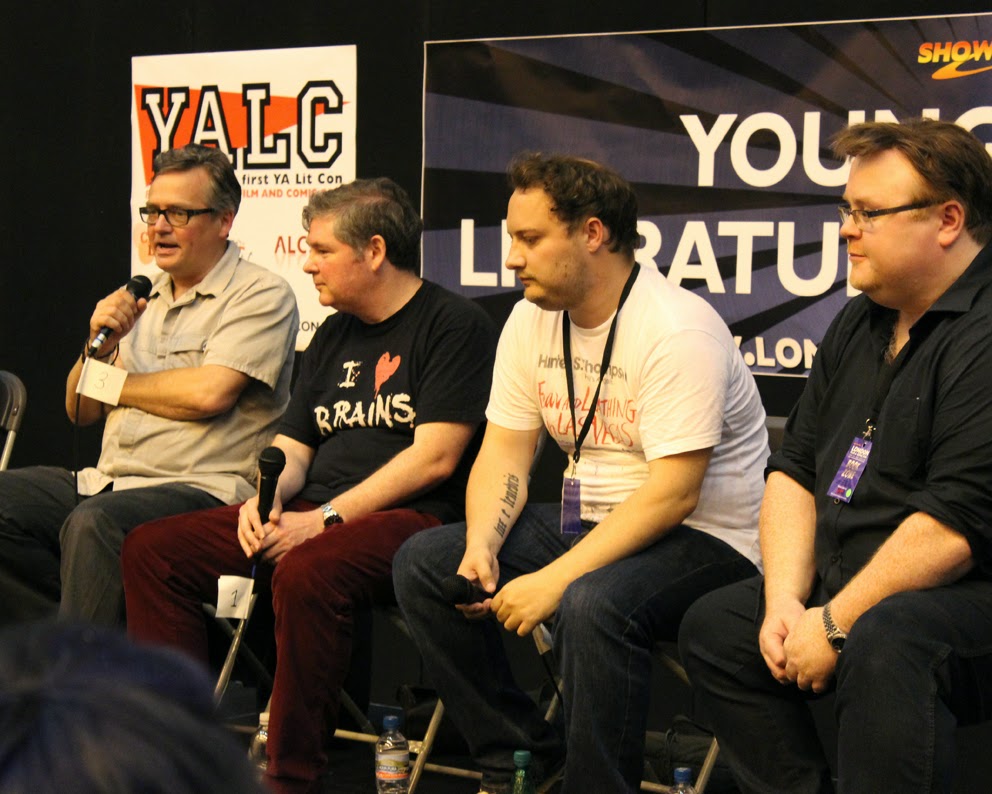
I thought I would share with you some snippets of wisdom from the YALC Panel events on Sunday 13th July. I’ve been a bit slow about getting to this, but I have an excuse. My mother in law is visiting so I have been busy entertaining her, taking her out and about. So apologies for my tardiness. The UK’s first ever YA Lit Con, curated by Malorie Blackman, exclusively at London Film and Comic Con, was held at Earl’s Court from 12-13 July 2014. First of all before I launch into telling you about the panel events I just want to say how much I enjoyed attending the YALC event. It was g-r-e-a-t!!!
My bookish daughter, and I went along together and had some lovely mother, daughter bonding time. This was great as she will be leaving the nest in September to go to University so these little moments are very precious to me. We were fortunate to be able to join in the activities on both the Saturday and the Sunday. Though we didn’t manage to go to the pre-view evening, which was a bit of a shame, as we missed out on getting an ARC of Landline. Quelle dommage! Anyway I have remedied this by buying one on-line for my daughter and I am sure she will be happy to lend her copy to me. She better or there will be high drama!
What was the event like?
Well we arrived a bit later than I would have liked but luckily I had a ticket that allowed us entry without joining the long queue. Sorry long queuers, I really felt for you. I am so glad I spent the extra money for the jump the queue tickets or else we would have been waiting a very, very, long time. The queues were ridiculously long. On arrival we were stamped, this kind of reminded me of my time as a University student. In those days a compulsory stamping was required to get into the Student Union for a night out. So that was a nice flashback in time. Unfortunately we took a while to get through the crowds to the very back of the far left hand corner of the event where the YALC was being held. It was a nice corner with soft beanie bags and bookish stands but boy did it take us some time to find it. Obviously they like to hide us bookish types away in a corner.
Consequently I missed the first workshop, Planning and writing a kiss-ass YA novel. So I was a tad disappointed. Though it turned out that all the workshops were organised on a put your name down and if you’re lucky you’ll be one of the thirty who gets to join in. I was not very lucky, in fact I only managed to attend one workshop all weekend. Still that one was super awesome. Meet the agent: speed pitching for authors, with Amanda Preston & Louise Lamont (LBA Books.) Believe me I need all the help I can get with a five-minute pitch. Speed is not my forte! Hey I do Tai Chi, 5 minutes, that’s how long I take to get out of bed in the morning!
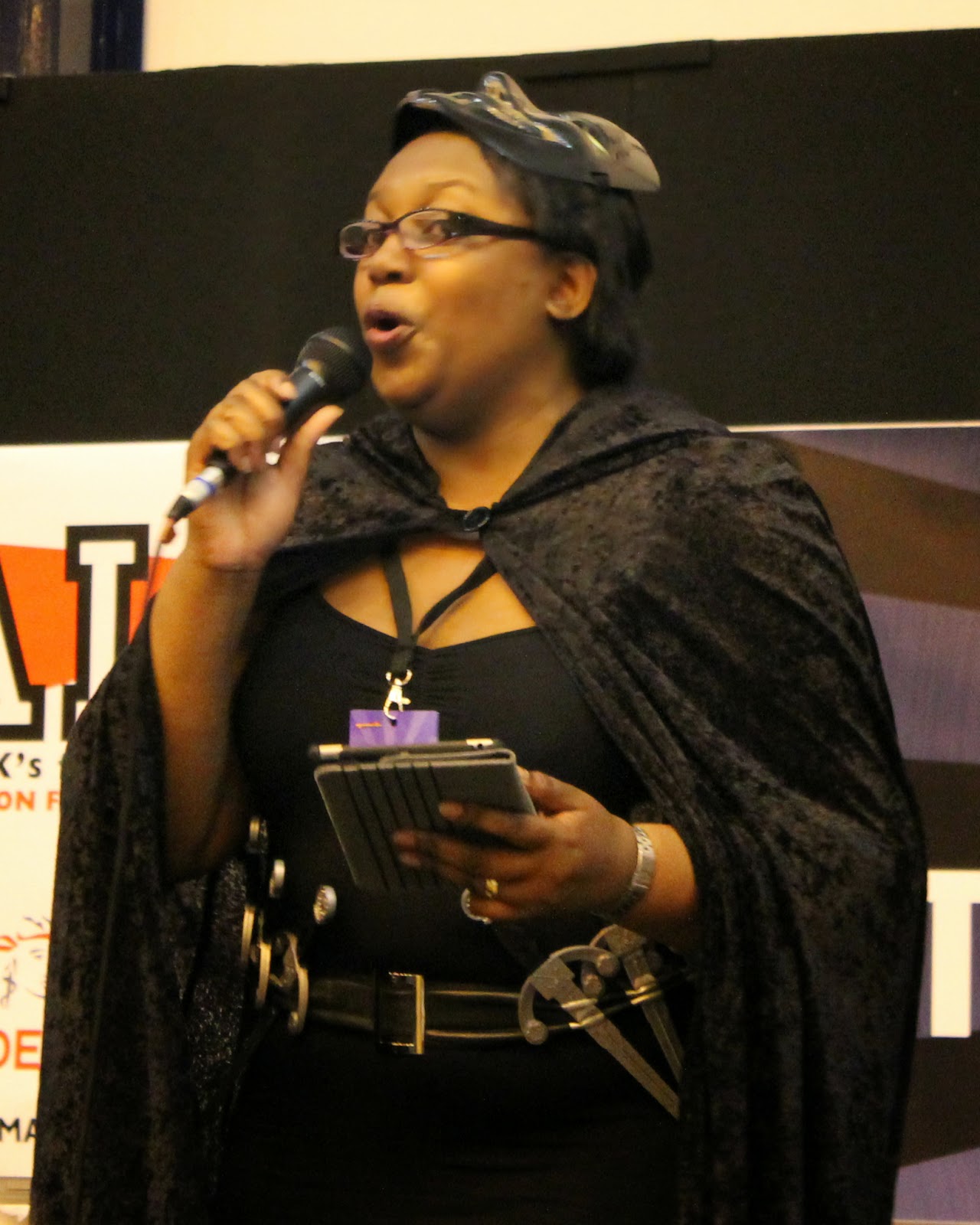
All the panel events were so entertaining, that I soon forgot my initial disappointment at not being able to attend the first workshop. On the Saturday, we began by finding a seat at the Dystopia panel event chaired by James Smythe, “It’s the end of the world as we know it: the ongoing appeal of dystopia,” with Malorie Blackman, Sarah Crossan and Patrick Ness. Malorie Blackman got right into the spirit of the event by dressing up!
Also we enjoyed Regenerating the Doctor: reimagining famous characters, with Charlie Higson, Andrew Lane, Patrick Ness and Marcus Sedgwick, chaired by Steve Cole, and Bring me my dragons: writing fantasy today, with Frances Hardinge, Amy McCulloch, Jonathan Stroud and Ruth Warburton, chaired by Marc Aplin.
Oh and last but not least, Heroes of Horror! With Charlie Higson, Will Hill, Derek Landy and Darren Shan, chaired by Rosie Fletcher. These guys just love killing off characters, oh and they have no intention of ever-growing up!
It was a Saturday full of books, and fun so it couldn’t have been more perfect. Oh, and the cosplayers were amazing there were Doctor Whos, Sherlocks, Witches, Manga/Anime characters, Game of Thrones, ……………. and some scary guy on stilts, very frightening.
On the Sunday, the first panel was at 11.30: How to get published with Phil Earle and Sally Green, chaired by Ben Horsten of Penguin Books. Ben Horsten began the panel talk by introducing us to Sally Green, debut author of Half Bad,the first in a series of three, and Phil Earle, author of Being Billy, Saving Daisy, Heroic, and The Bubble Wrap Boy. Phil Earle took five years to get into writing. He changed his career and became a children’s bookseller. During his time as a bookseller he developed an interest in literature, and in particular, young adult fiction. In the panel event Phil Earle emphasised the importance of finding the right home for your writing. Trust your gut instinct. If you find the right home they will believe in you and do all they can to help you succeed. Sally Green agreed that it was important to have a good working relationship with publishers.
Are editors “Angels and devils?” Or are they a mix of both? Sally recommended learning how to edit your own book. Having feedback buddies, analysing other people’s work, and developing a willingness to change, learn, and improve. I totally agree, I am a member of a writing group here in Cambridge and have found this really helpful. Sally’s advice is to keep on going, even the most famous authors can take a long time to get there. She mentioned that Iain Banks wrote three books before the Wasp Factory was successful and he didn’t give up.
Phil Earle emphasised the buzz, and encouragement that editors can build. Phil jokingly said that when you approach an agent, or an editor make sure that you stay sober! No Stalking! “Don’t chase the market.”
Ben Horsten of Penguin Books is on the look out for writing that inspires his attention and has different kinds of polish. It has to have an amazing voice. A nugget, a ‘Je n’ai sais quoi.’ It is a tough market for debut writers, but don’t despair publishers are on the look out for the next generation of writers.
Phil Earle discussed debut writers. He said that debut writers have a unique quality, they are bright and shiny. Bloggers like debut writers. I have to agree with Phil Earle on this one. There is nothing like encouraging a new writer to find their voice and succeed in a difficult market. Again, writing communities are great, as are blog sites, and wattpad. But above all else be suggested be passionate!
Phil Earle has used editing agencies – Cornerstones – and found this useful. Sally was a bit wary of parting with money and suggested swapping manuscripts with other authors. Given her background – I believe she was an accountant before the creative bug hit her, this sounds likely advice from Sally! I’m also a bit loathe to part with money too, I’m sort of with you on this one Sally, but we’ll see I may have to succumb, and pay. At the moment I’m using trusted people to read and give feedback on my manuscript. Hopefully that will be enough.
Sally emphasised the importance of working on your manuscript, and not getting too side tracked by social media! Good advice! Wish I had thought of that!
Ben Horsten suggested checking out profiles of a few authors and how they connect with their fans on social media. This sounds like great advice……
Other snippets of writer advice from the panel: Develop a good profile on twitter. Find an agent, using the twitter hastag, #askanagent. Make sure your first three chapters are the best they can be and also that you have a two-line pitch that delivers, and your synopsis just cries out to be read.
My advice: When attending these events remember to bring food and a lot of water. A nice sandwich would be awesome. It was very hot and sweaty inside the venue. So wear minimal clothing, but don’t get arrested. In fact I felt quite sorry for some people who were dressed in elaborate costumes, how could they possibly survive? So come prepared. Let’s hope that YALC is an annual event, I want to go again! Oh and next time I want to dress up! I wore my glasses this time, next time who knows what I will look like!

















 M J Mallon YA Author and Poet